
Travel retail punishes vague scope more than any other channel, because the product has to be correct in several markets at once and the listing date cannot move. A China-based perfume OEM can cover everything from compounding to the finished gift box, but only if the brand writes down where its responsibility stops. The checklist below is the minimum a first-time brand should settle before asking for prices.
Key takeaways
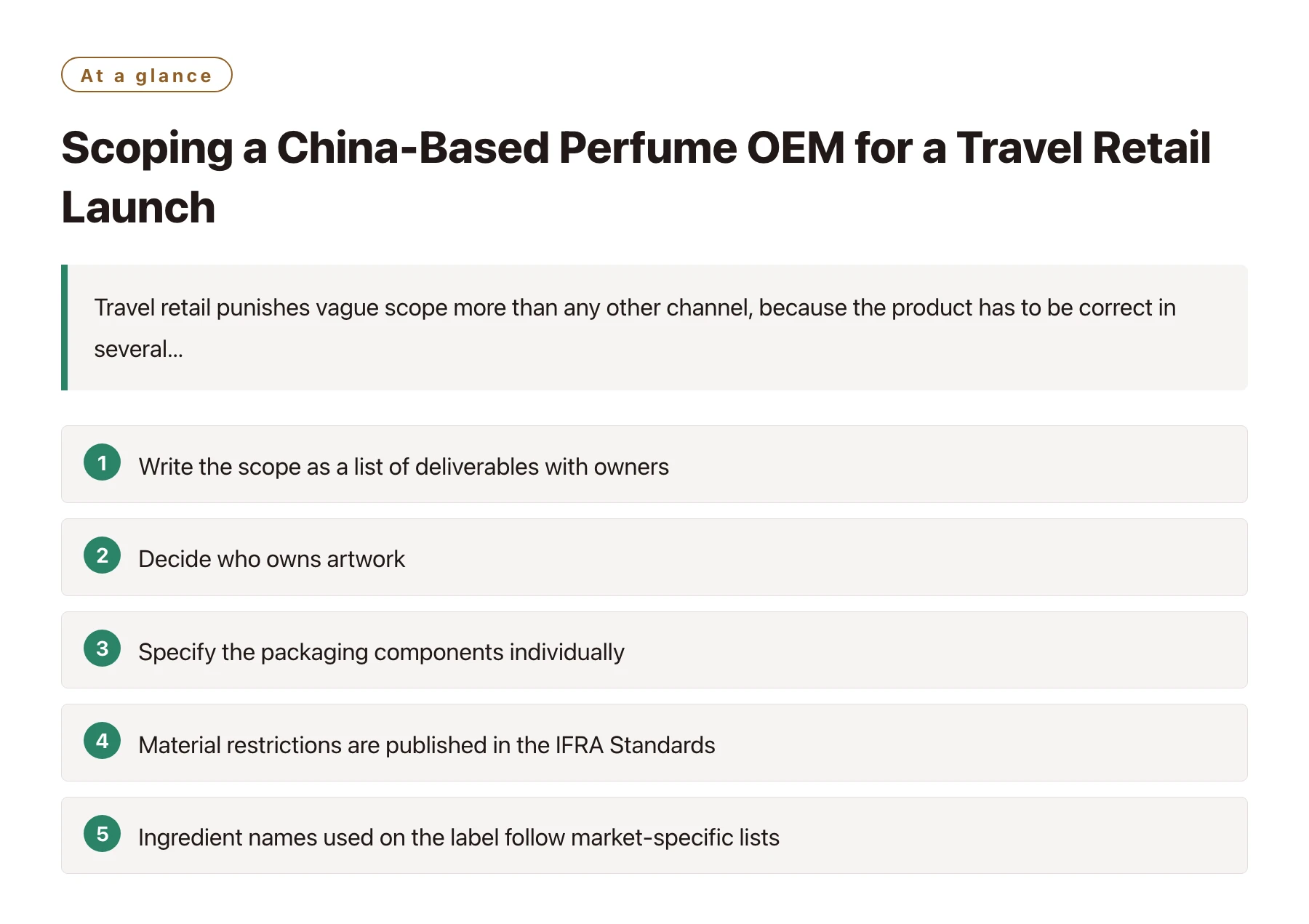
- Write the scope as a list of deliverables with owners, not as a description of services, because travel retail buyers ask for the deliverable and not the description.
- Decide who owns artwork, labelling compliance and market-specific text before sampling starts, since those tasks run on a different calendar from the fragrance.
- Specify the packaging components individually, because a fragrance that passes as a 50 ml bottle may fail as a 10 ml miniature or as part of a boxed gift set.
- Material restrictions are published in the IFRA Standards, and the certificate of conformity that documents them is a deliverable the brand should hold [1].
- Ingredient names used on the label follow market-specific lists, so the same formula may need different label text in different countries [2].
A first travel retail launch usually starts with a listing conversation and works backwards to manufacturing. That direction of travel is what makes scope slippery: the brand knows what the shelf needs, and the factory knows what the line can do, and nobody has written the bridge between them.
The sequence below is designed to be completed on paper in a single sitting, then attached to the enquiry. It costs nothing at that stage and removes most of the rework that follows.
The scope checklist, in the order it should be settled
- Name the markets the product will be sold inList every country the listing touches, including countries reached through a distributor. Labelling, ingredient naming and documentation all follow from this list, and adding a market later is the most expensive kind of change.
- Fix the pack formats before the formulaDecide whether the launch includes a miniature, a tester, a travel spray and a gift set. Each format is a separate compatibility question, and a set adds the question of how the fragrance behaves next to a body product inside one box.
- Write the fragrance brief with a cost ceiling attachedGive the brief a target concentration range and a target unit cost together. A brief with no ceiling produces a beautiful submission that cannot be produced at the channel's margin.
- Define the decorative scope line by lineList bottle, cap, pump, collar, label, carton, insert, shrink and security element separately, and mark each as supplied, sourced or decorated by the factory.
- Assign every document an ownerAllergen declarations, safety documentation, certificates of conformity and artwork approvals each need a named owner on one side or the other. A checklist of deliverables is the cleanest way to do it.
- Agree what happens at each production gateName the gate checks, who attends, and what a rejection costs. Travel retail stock is often non-returnable, so a rejected pallet is a direct loss rather than a delay.
- Set the change rule and the shipping assumptionState how a change to the formula or pack is priced, and whether freight, duty and documentation for the destination are inside the quoted figure or outside it.
Where first scope lists leave gaps
Labelling across several markets
A travel retail assortment often sits on one shelf with products labelled for different destinations, and the label text is not identical between them. Some markets require a specific ingredient naming convention, others require particular warnings or a nominated responsible party, and the artwork has to accommodate all of it without a redesign at the last minute.
This is why labelling should be scoped as a deliverable with a schedule rather than as an afterthought on the artwork file. Trade bodies representing the cosmetics industry publish guidance on how this patchwork is managed in practice, which is a useful sanity check on any supplier that claims the label is trivial [3].
Decoration, tooling and lead times
Decoration is where a travel retail gifting line diverges from a standard fragrance line. Metallising, hot stamping, soft-touch coatings and multi-piece cartons all carry their own tooling and their own approval loop, and a sample of a decorated bottle is not the same as proof that the decoration survives handling.
Ask the factory to state whether tooling already exists for each component and, if a new tool is needed, where the tool is made and how long the first article takes to approve. For a launch aimed at a fixed listing date, that single answer changes the whole plan.
Industry coverage of launches is also worth reading before the packaging conversation, because it shows how often a fragrance line is judged on its format rather than its scent at the shelf [4].
Testing and documentation ownership
Brands often assume the factory holds everything. Factories often assume the brand will ask for what it needs. The gap between those two assumptions is filled with rework, and the cheapest way to close it is a one-page document schedule that lists each deliverable, its owner and its due date relative to the shipping date.
When the scope is written this way, an OEM enquiry becomes comparable. The brand can ask two suppliers the same question and see the same shape of answer, and the choice between them turns on capability and price rather than on interpretation. It also becomes clear whether the supplier really covers development, compounding, filling and packaging under one roof, as Xuelei Fragrance describes, or whether the packaging sits with a third party who will appear later as a schedule risk.
Reading a manufacturer's guidance on factory selection alongside your own checklist is a good way to catch what you have missed. A structured explainer such as Xuelei covers capacity, sample discipline and documentation in one place and is quick to work through.
The final note is about naming. A brand searching for a perfume manufacturer in China will find both trading companies and factories presenting themselves in the same way, and the scope list is the fastest way to tell them apart: a factory can commit to compounding and filling dates, while an intermediary can only relay them.
What the scope document should say explicitly
| Scope area | What to write down | Who normally owns it |
|---|---|---|
| Fragrance development | Number of submission rounds and how revisions are priced | Supplier, with brand approval at each round |
| Conformity documents | Which certificates are issued and in whose name | Supplier prepares, brand holds |
| Label and artwork | Market list, mandatory text and who checks compliance | Split, agreed in writing |
| Pack and set assembly | Component list, decoration method and tooling ownership | Supplier, unless components are free-issued |
| Logistics | Incoterm, packing standard and who clears the destination | Named per shipment, not assumed |
A scope document that answers these five lines is already better than most briefs, and it costs one afternoon to produce.
If a supplier's quotation does not reference your scope list line by line, do not compare the totals. Ask for a revised quotation against the list, then compare.
Sources
- IFRA Standards Library (International Fragrance Association) —— The IFRA Standards Library lists the restrictions the fragrance industry applies to individual fragrance ingredients, based on safety assessments; it is the reference point for compliant fragrance formulation.
- EU CosIng — Cosmetic Ingredient Database (European Commission) —— The European Commission's CosIng database of cosmetic ingredients, listing ingredient functions, restrictions and labelling requirements under EU cosmetics law.
- Cosmetics Europe —— The European trade association for the cosmetics and personal care industry, publishing guidance, positions and market information.
- Cosmetics Business —— A trade publication covering the beauty and cosmetics industry, including fragrance launches and regulatory developments.
Frequently asked questions
How much detail should a scope list contain before requesting a quote?
Enough that the supplier can respond line by line: markets, formats, component list, decoration methods, document deliverables and the shipping assumption. Anything less produces a quote built on assumptions you cannot see.
Do we need separate samples for each travel retail format?
Yes for the miniature and the tester, which behave differently from the retail bottle. A gift set should at least be tested as an assembled unit.
Who is responsible for label compliance in each market?
Responsibility ultimately rests with the brand placing the product on the market, even when the review is delegated to the supplier. Assign a named reviewer on both sides.
Is it cheaper to source packaging separately from the fragrance?
Sometimes on unit cost, rarely on schedule. Separating them adds a coordination layer and typically adds a compatibility loop, so compare total landed cost and timeline rather than component price alone.
What is the most common cause of a missed travel retail date?
A change after the pack was finalised, usually a decoration or label revision. Both sit on tooling and artwork calendars that cannot be compressed at short notice.